Cards and chips arranged on a round table under warm light
Spoiler-Rich Narrative Analysis

Plot Breakdowns

Act-by-act deconstructions of casino cinema: turning points, scene objectives, reversals, visual motifs and the character decisions that make an ending feel inevitable in retrospect.

Featured Breakdown · Casino (1995)

The disintegration of order

The film begins with an explosion, then spends the rest of its running time explaining the chain of decisions that made that image possible.

Cards and chips arranged on green felt
Act I · System

Competence creates the illusion of invulnerability

Ace is introduced through expertise. Explanatory voiceover and controlled visual detail establish a world that appears legible because he can describe it. The dramatic trap is already present: the more completely he can explain the institution, the more he believes explanation equals control.

Act II · Friction

Private relationships become public variables

The middle movement layers incompatible pressures. Nicky’s visibility undermines a system built on discretion, while Ace’s need to manage personal relationships as if they were operational problems intensifies conflict. The narrative does not rely on a single reversal; it accumulates stress.

Act III · Exposure

The machine survives by replacing the people

Once scrutiny becomes unavoidable, the institution’s logic changes. Individual authority proves temporary. The ending reframes the story as one about systems that can absorb new management while the people who believed they owned the system are scattered by consequence.

The Archive of Screen Bets

Breakdowns by narrative engine

Filter the archive by the mechanism that primarily drives tension.

Rounders · 1998

The tell as narrative ignition

Mike’s journey works because external debt and internal identity point toward the same rematch. Each return to the table narrows the distance between the person he performs and the person he chooses to become.

Ocean’s Eleven · 2001

Precision choreography and withheld information

The film explains enough of the plan for the audience to measure progress, then withholds one crucial layer. The reveal succeeds because the concealed information reinterprets earlier scenes rather than contradicting them.

Molly’s Game · 2017

The ledger of control

The narrative alternates construction and reckoning. Success is narrated with velocity, while later scenes force a slower reconsideration of what that success required from the central character.

Uncut Gems · 2019

Complication as forward motion

Nearly every solution generates a new obligation. The screenplay keeps several clocks running at once, so scenes arrive already pressurised by unfinished business from somewhere else.

The Sting · 1973

Fair-play misdirection

Audience knowledge is rationed with unusual discipline. We understand enough to enjoy craft, yet the decisive layer of the con is saved until it can transform apparent failure into design.

Hard Eight · 1996

Backstory as delayed moral weight

The film allows behaviour to precede explanation. When past connections are clarified, earlier acts of mentorship acquire a different moral texture without losing their emotional ambiguity.
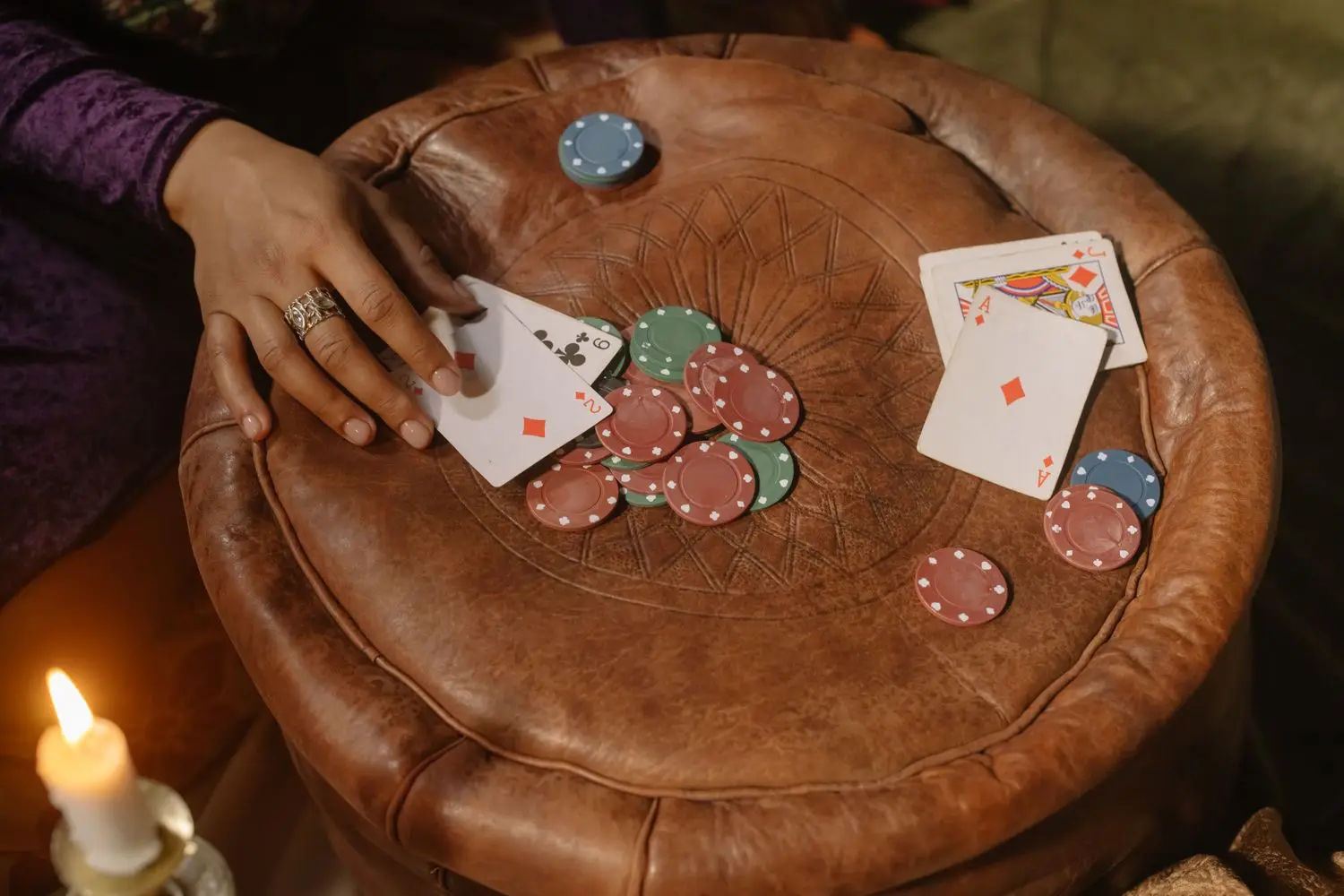

Key Scenes & Cinematography

How a scene turns mechanics into drama

Rules matter only because they let the audience understand what a shot, pause or reversal means.

Dealer position and table under focused light

The overhead eye

High angles can transform individual players into components within a managed system. Cutting from surveillance geometry to close reaction shots then exposes the gap between institutional knowledge and private intention.

Cards and dice arranged in a vintage setting

The repeated object

A prop becomes meaningful through recurrence. Once the audience has learned a character’s ritual, the smallest variation can function like a line of dialogue.

Players at a table viewed from an intimate angle

The held reaction

Suspense increases when the film delays the face we most want to see. The edit creates a question, and the withheld reverse shot becomes the answer.

Thematic Spotlights

Chance versus control

The genre repeatedly asks whether a disciplined method can protect a person from uncertainty—or merely make uncertainty easier to deny.

The myth of the perfect score

Heist films often begin with an image of total preparation. Drama enters through the variable that planning cannot fully model: a person, a timing error or an emotional decision.

Bluffing as identity

A bluff is dramatically useful because it makes appearance and truth diverge. Filmmakers can extend that principle beyond the table into romance, leadership, loyalty and self-image.

The cost after the climax

The most resonant films do not treat the decisive hand or successful operation as the end. They ask what the characters must live with once the immediate suspense is over.

Breakdown FAQ

Reading the structure

Our method is designed for readers interested in screenwriting, editing and narrative theory.

Acts are an analytical map, not a claim that every screenplay follows a rigid formula. They help identify changes in objective, pressure and consequence, especially when several plot lines converge.

It is a moment when the plot could plausibly move in more than one direction and a character’s choice determines which path follows. These moments connect structure to psychology.

Yes. Plot breakdowns discuss endings, reversals and structural reveals because those elements cannot be analysed meaningfully while being hidden.